2  Author information: names, dates, gender, and profession

Author-level information in Fennica, including names, authority identifiers, dates, gender, profession, language, and other biographical metadata for the complete dataset and the 1809–1917 subset.

3 Author database

3.1 Description

The author database provides an author-level view of people associated with publications in Fennica. It combines information recorded in the MARC 100 field for main authors and the MARC 700 field for added authors.

Authors are identified primarily through Asteri authority identifiers when these are available. Asteri identifiers make it possible to connect different name forms referring to the same person and to link bibliographic records with information from the Kanto national authority database.

Authors without an Asteri identifier are retained using harmonized author names. This makes it possible to include authors who occur in Fennica but do not have an authority identifier.

The database therefore combines information from two main sources:

  • Fennica bibliographic records, including author names and publication information; and
  • Kanto authority data, providing additional biographical and authority information.
Datasets presented on this page

Two versions of the author database are presented below.

Complete Fennica author database contains authors associated with records across the complete harmonized Fennica dataset.

1809–1917 author database contains authors associated with publications included in the historical 1809–1917 subset.

The 1809–1917 database is therefore a subset of the complete author database.

3.2 Author identification

Information used to identify authors includes:

  • harmonized author names;
  • alternative and variant names;
  • Asteri authority identifiers;
  • names extracted from MARC 100 and MARC 700 fields; and
  • links between authors and Fennica bibliographic records.

A single author may appear in multiple Fennica records and may be represented by several name forms in the original bibliographic metadata.

3.3 Biographical information

Where corresponding authority information is available, author records are enriched with variables describing the person, including:

  • birth and death dates;
  • calculated age;
  • gender;
  • profession;
  • title;
  • field of activity;
  • language;
  • country; and
  • associated places.

The availability of these variables differs because not every author has an Asteri authority identifier and not every Kanto authority record contains the same amount of biographical information.

3.4 Publication activity

The database also contains variables describing an author’s occurrence in Fennica. Publication activity is calculated from the publication years of records associated with each author and includes measures such as:

  • number of associated Fennica records;
  • first observed publication year;
  • last observed publication year;
  • mean publication year; and
  • observed publication activity span.
Interpretation

Publication activity refers to an author’s representation in Fennica. It should not necessarily be interpreted as the author’s complete publication history.

Similarly, missing biographical information does not mean that the information is historically unknown. It means that the information could not be obtained from the bibliographic and authority metadata used in this workflow.

4 Complete Fennica dataset

This section describes authors found across the complete harmonized Fennica dataset, without restricting records by publication year.

4.1 Coverage of author information

The complete author database contains 1318063 author records.

The statistics below show how many author records contain information for each variable. Percentages are calculated relative to all author records in the complete database.

Asteri identifier:
535605 authors (40.6%).

Author dates:
487333 authors (37%).

Death year:
198891 authors (15.1%).

Calculated age:
194712 authors (14.8%).

Gender:
525404 authors (39.9%).

Profession:
353324 authors (26.8%).

Field of activity:
339858 authors (25.8%).

Language:
225373 authors (17.1%).

Country:
121371 authors (9.2%).

Place:
0 authors (NaN%).

Reading the coverage statistics

The percentages above describe metadata availability, not the proportion of authors possessing a particular characteristic.

For example, the gender percentage indicates the proportion of author records for which gender information is available, rather than the distribution of genders in Fennica.

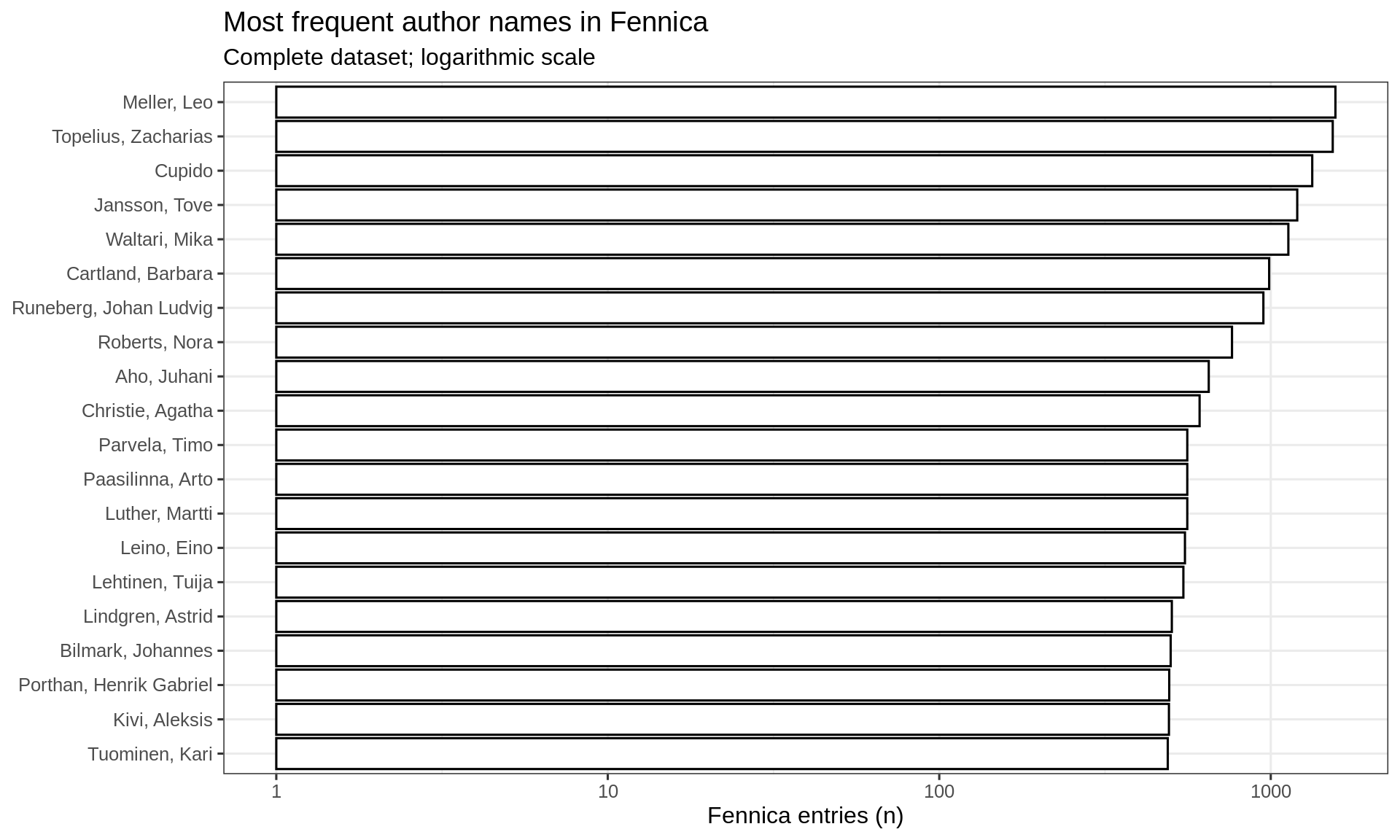
4.2 Most frequent author names

The following figure shows the author names associated with the largest number of Fennica entries in the complete dataset.

The y-axis is presented on a logarithmic scale because the number of associated records is highly uneven: a small number of authors occur very frequently, while most authors occur in relatively few records.

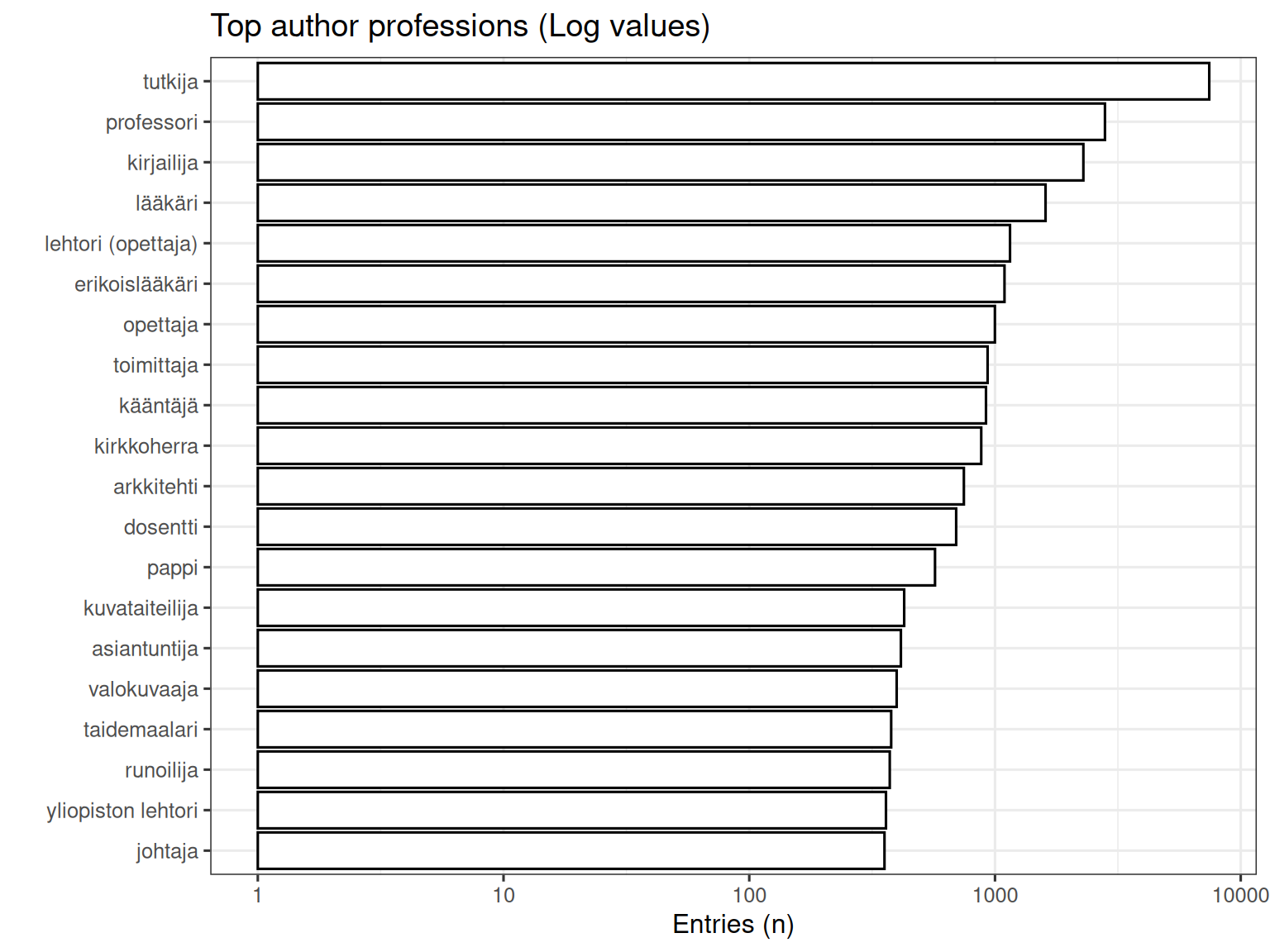
4.3 Profession

The profession variable originates from authority information associated with the author. An author may have more than one profession recorded.
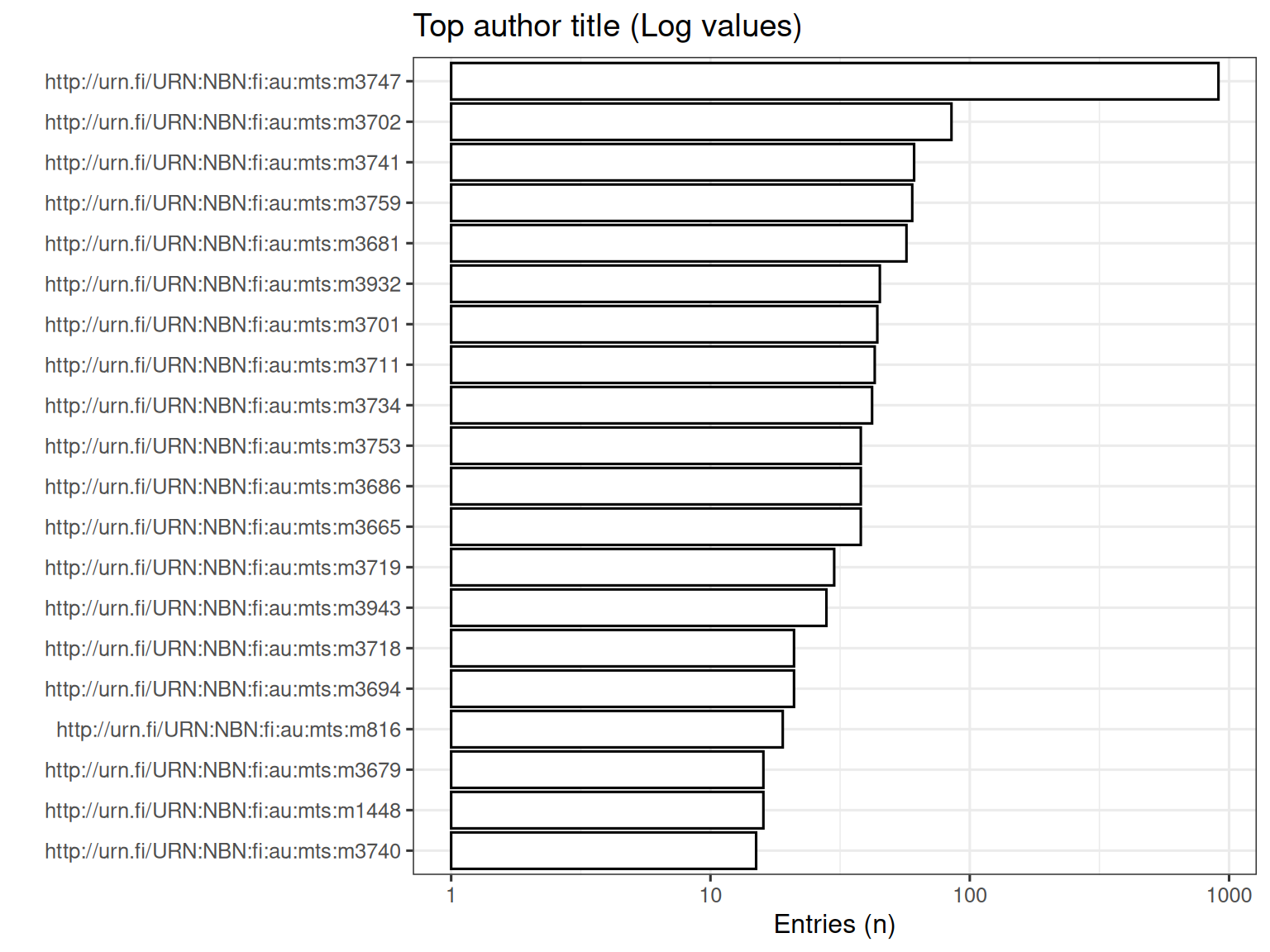
4.4 Titles

Titles describe titles or designations associated with persons in the authority data.
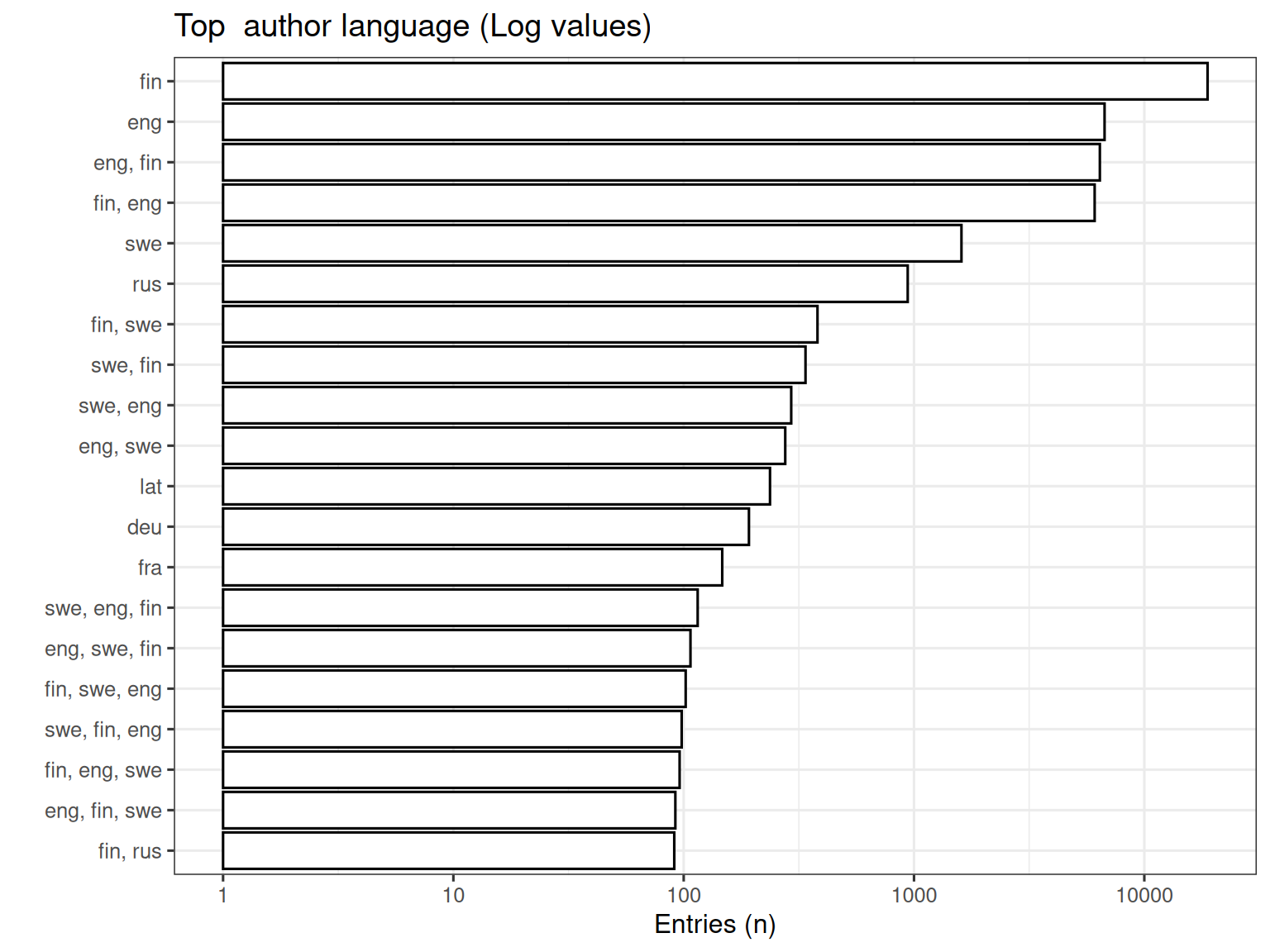
4.5 Language

Language information describes languages associated with persons in the authority data. It should therefore not be interpreted directly as the publication language of the corresponding Fennica records.
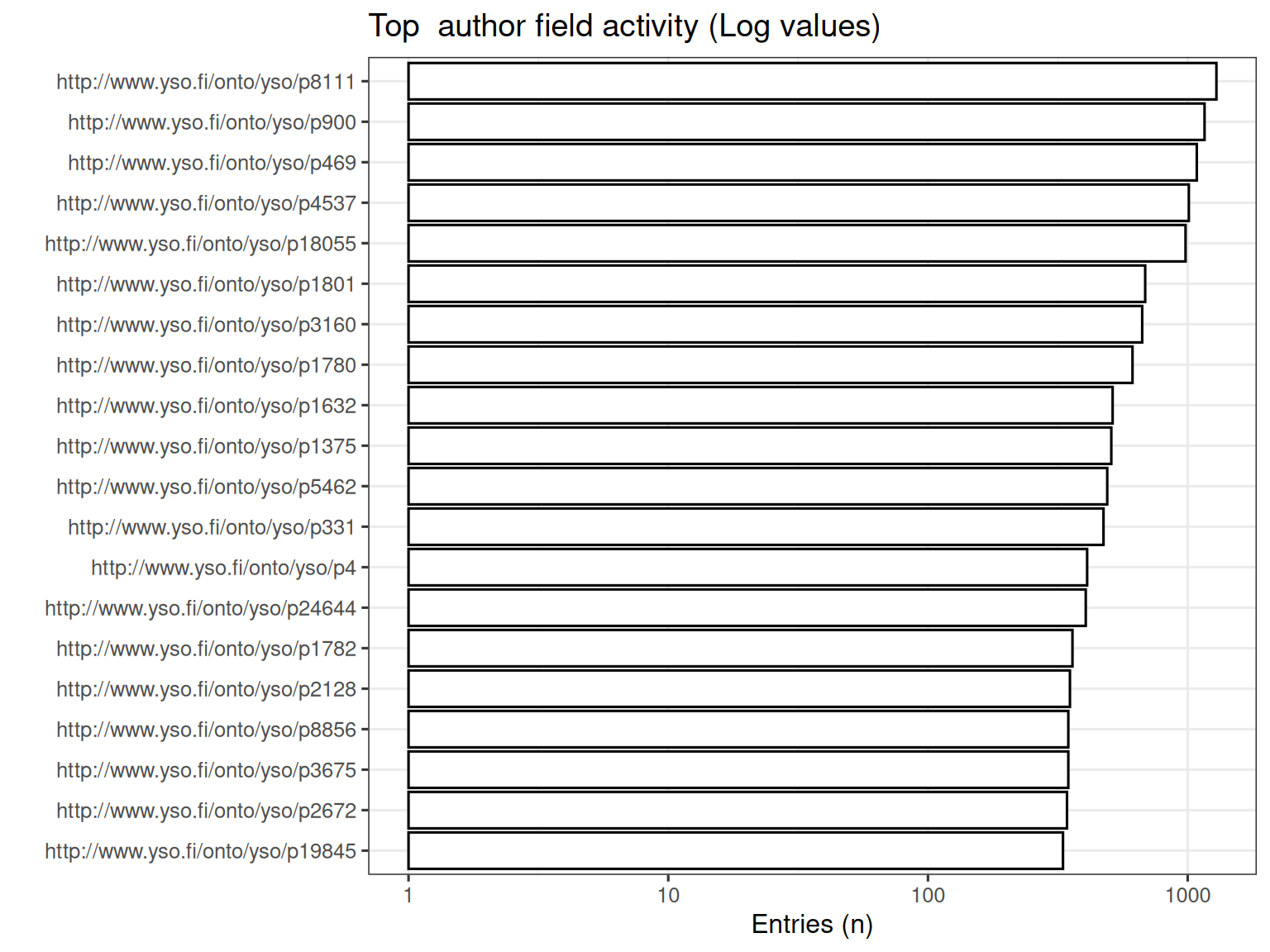
4.6 Field of activity

Field of activity provides a broader description of the professional, intellectual, artistic, or other fields associated with a person in the authority data.
4.7 Country

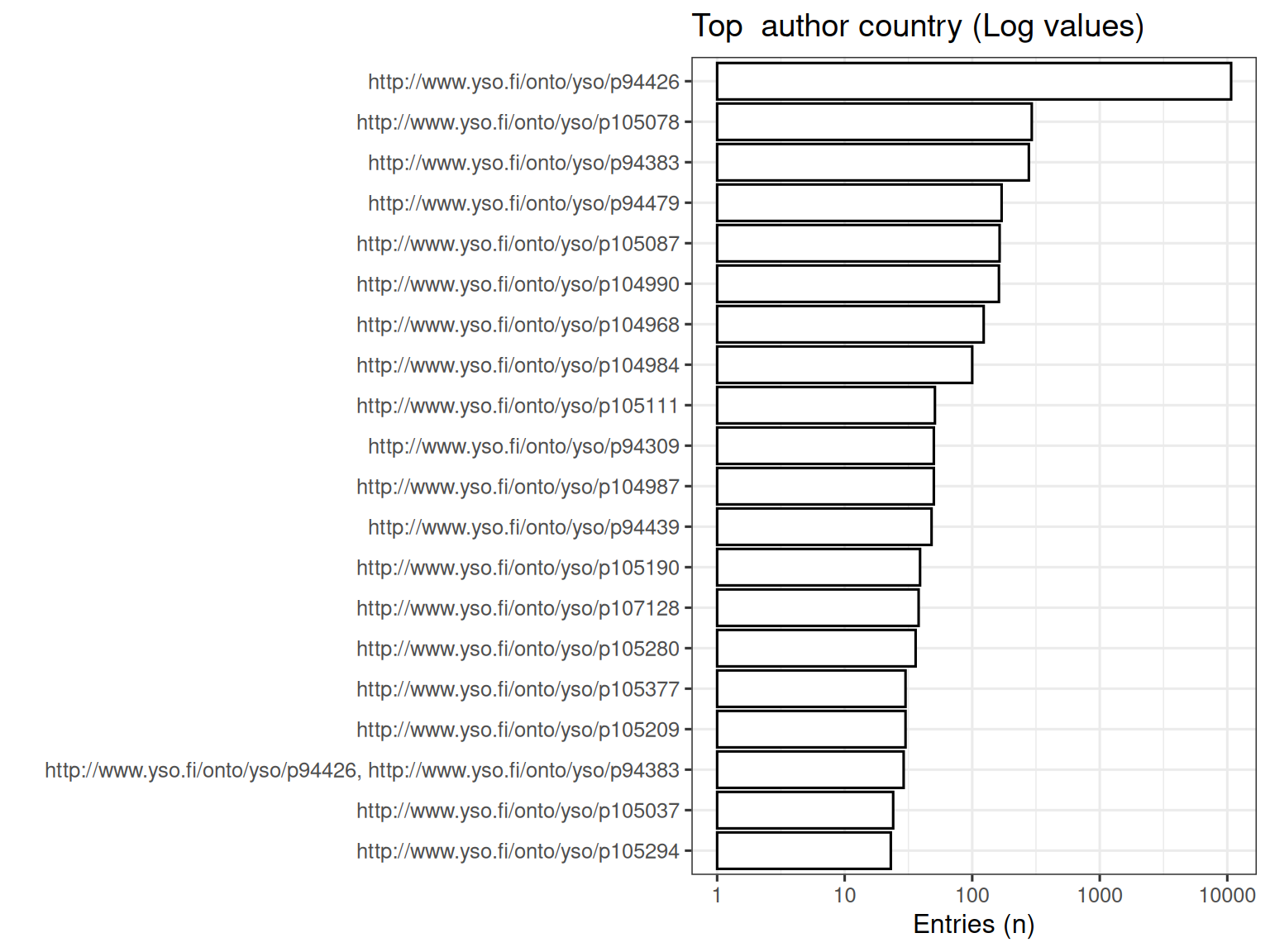
Country information is derived from authority metadata and describes countries associated with individual authors.
Download the complete Fennica author database

5 Authors in publications from 1809–1917

This section focuses on authors associated with Fennica publications included in the 1809–1917 historical subset.

Restricting the database to this period provides a more relevant description of authors represented in the nineteenth-century and early twentieth-century material used in the historical analyses.

What does 1809–1917 refer to?

The period refers to the publication years of the Fennica records, not to the birth years, death years, or active years of the authors.

An author can therefore appear in this subset even if their lifetime extends considerably before or after 1809–1917.

5.1 Coverage of author information, 1809–1917

The historical subset contains 72626 author records.

The statistics below describe metadata availability specifically among authors associated with publications from 1809–1917.

Asteri identifier:
35281 authors (48.6%).

Author dates:
32050 authors (44.1%).

Death year:
31469 authors (43.3%).

Calculated age:
31336 authors (43.1%).

Gender:
33531 authors (46.2%).

Profession:
25679 authors (35.4%).

Field of activity:
15488 authors (21.3%).

Language:
12316 authors (17%).

Country:
6015 authors (8.3%).

Place:
0 authors (NaN%).

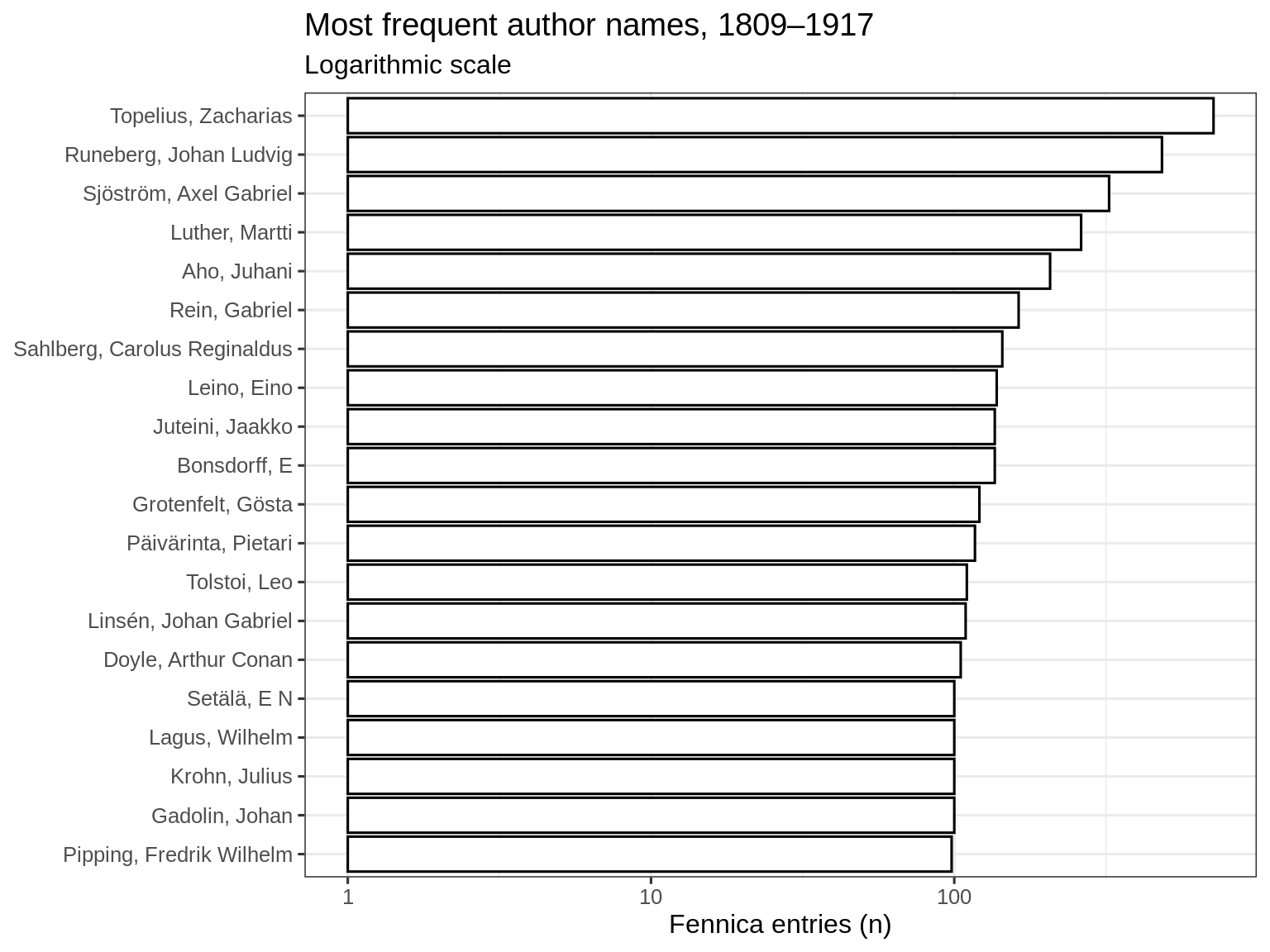
5.2 Most frequent author names, 1809–1917

The following figure shows authors associated with the largest number of Fennica records published between 1809 and 1917.
6 Author characteristics, 1809–1917

The following sections describe selected biographical and authority variables for authors represented in the historical subset.

6.1 Gender

Gender information is based on the harmonized gender_primary variable. Authors for whom gender information is unavailable are excluded from the percentage calculation below.

Gender distribution among authors with available gender information, 1809–1917.
Gender Authors (n) Fraction (%)
male 30533 91.1
female 2959 8.8
male/male 29 0.1
female/male 7 0.0
male/female 3 0.0
Gender percentages

The percentages are calculated only among authors for whom gender_primary is available. Authors with missing gender information are not included in the denominator.

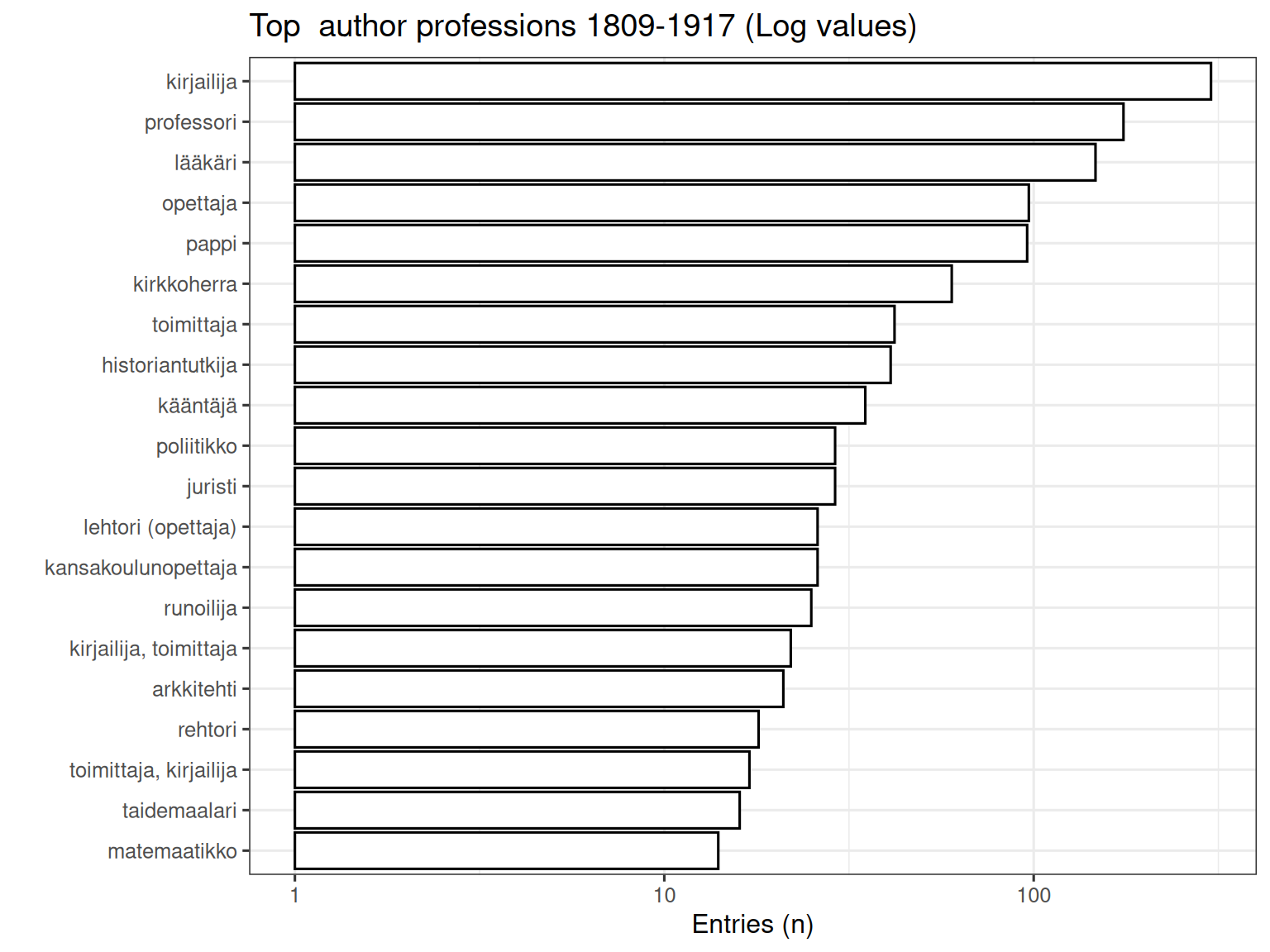
6.2 Profession

The following figure shows the most frequently recorded professions among authors associated with publications from 1809–1917.
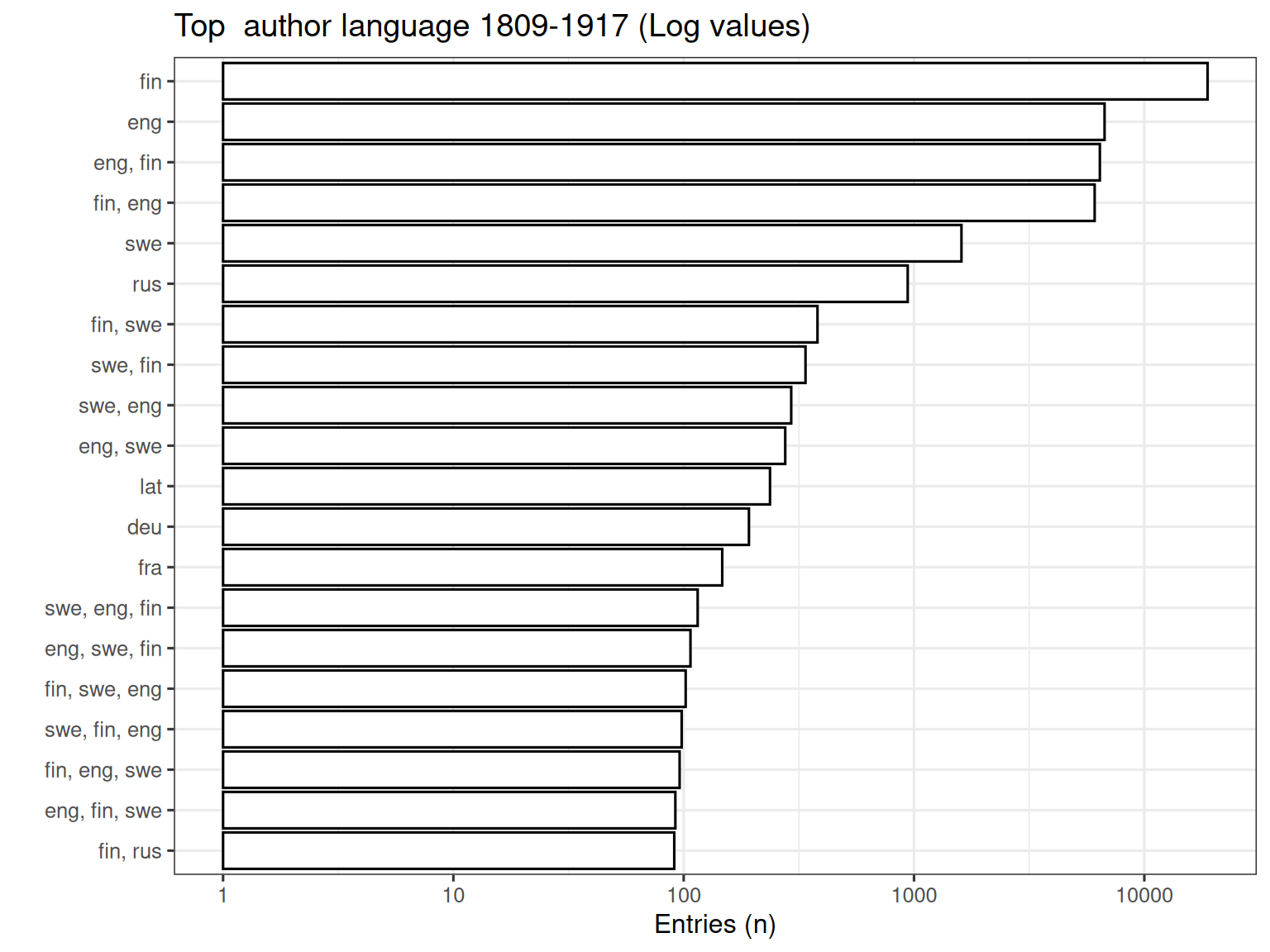
6.3 Language

The following figure shows the most frequently recorded languages associated with authors in the historical subset.

These values originate from person-level authority metadata and should not be interpreted as the language of the publications themselves.
Download the author database for publications from 1809–1917